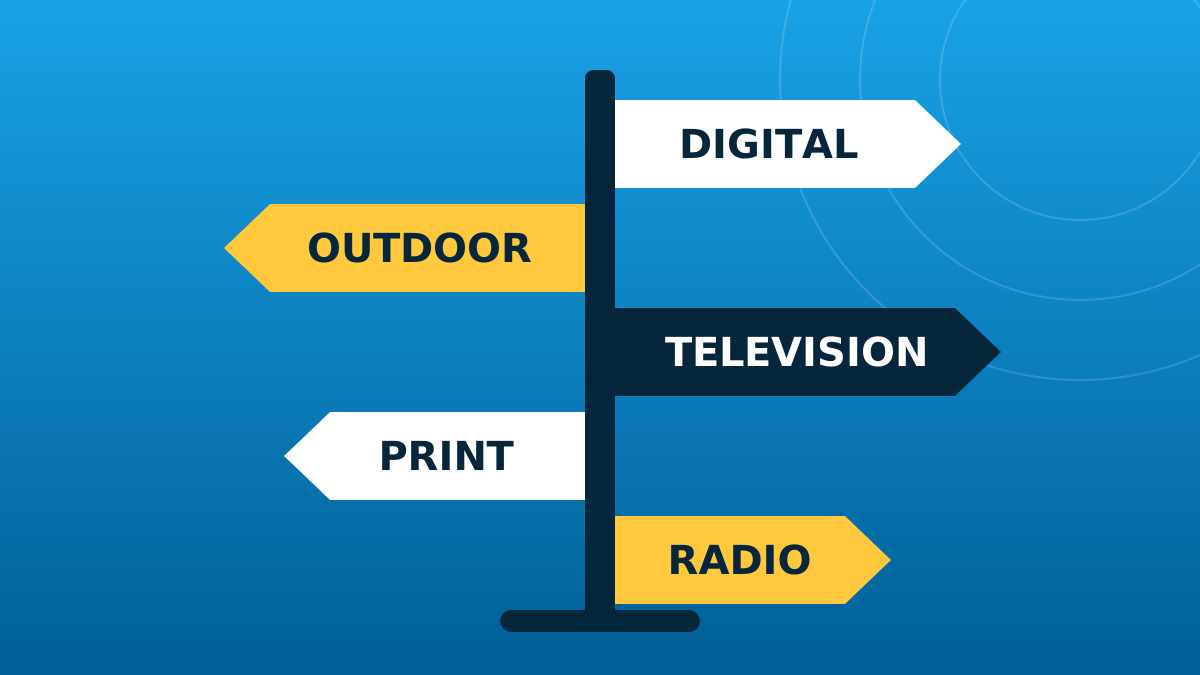
Newspaper or Instagram? Hoardings or Google? Most businesses start with the channel. Start with your business goal instead, and the channel question becomes much easier.
Step 1: Decide what the campaign needs to achieve
Awareness, enquiries, website visits, store visits and sales are different objectives. Each favours different media. A launch that needs the whole city to know your name is not the same job as filling next week's appointment book.
Step 2: Understand your target audience
Write down their age range, location, interests and media habits, and how they decide. Some purchases are impulsive. Others take weeks of comparison. The longer the decision, the more touchpoints you need.
Step 3: Compare the available advertising media
- Print: newspapers and magazines. Strong for credibility and detailed offers.
- Television: wide reach with sight, sound and emotion.
- Radio: frequent, local, good for reminders and offers.
- Outdoor: hoardings and road medians. Constant presence in a chosen area.
- Search: reaches people at the moment they are looking.
- Social media: precise targeting and conversation.
- Display and video: visual reach across websites and apps.
Step 4: Consider geography, reach and frequency
If your customers come from a five-kilometre radius, city-wide media wastes money. If you sell across the state, a few local sites will not be enough. Then decide how often people should see you. Repeated exposure usually matters more than one grand appearance.
Step 5: Set a realistic budget
Count production costs as well as media costs, and allow for the campaign's full duration. Keep a part aside to test and review. A modest budget concentrated on two channels generally does more than the same money scattered over six.
Step 6: Decide how results will be measured
Match the measure to the objective: reach for awareness, calls and forms for enquiries, footfall for store visits, conversions for sales. Poor planning here is one reason great advertising fails without a media strategy.
A simple media selection checklist
| Objective | Audience | Suitable channels | Budget notes | Possible measures |
|---|---|---|---|---|
| Awareness | Broad, city or state | TV, outdoor, print, video | Higher media cost; needs duration | Reach, recall surveys |
| Enquiries | People actively looking | Search, social, print | Start small, scale what works | Calls, forms, messages |
| Store visits | Nearby residents | Outdoor, radio, local digital | Concentrate near the outlet | Footfall, offer redemptions |
| Sales | Warm, ready to buy | Search, retargeting, social | Track cost per sale | Conversions, revenue |
A local bakery wants weekend footfall. It picks two hoardings on nearby main roads, area-targeted social ads and a radio spot on Friday evenings. A furniture brand selling across Telangana wants enquiries. It picks search ads, regional newspaper inserts and video. Both are illustrations to show the decision process, not client results.
Choose media for a reason
Every channel in your plan should be there because of your objective, your audience and your budget. If the only reason is "everyone is on it", look again. Our media buying team plans across television, print, radio, outdoor and digital for exactly this reason.
Not sure which mix fits your business? Let's work out the right media for your goal.
Talk to Finishing Pointe